
Harnessing the Power of Capitalism
It is easy to look at today’s headlines and conclude that the world is becoming increasingly uncertain, divided and fragile. Viewed through the lens of the twenty-four-hour news cycle, it can often feel as though progress is moving backwards.
Yet the longer-term evidence presents a remarkably different picture. Since 1990, the number of people living in extreme poverty has fallen from around 2.3 billion to approximately 831 million. Annual deaths of children under the age of five have fallen from around 12.5 million to less than 5 million. More than two billion additional people now have access to safely managed drinking water. Life expectancy, literacy rates and access to electricity have all improved materially over the same period[1].
This reminds us that, despite the noise and setbacks along the way, humanity has become healthier, wealthier and more productive over time.
The figure below tracks the improvement in both wealth and health around the world from 1800 to 2025. People today live longer, healthier and wealthier lives than at any point in human history. The scale of this progress is remarkable.
Figure 1: Increases in Global Health and Wealth from 1800 to 2025
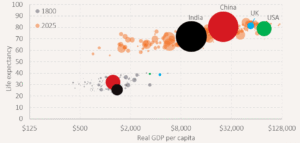
Source: Albion Strategic Consulting. Data source: gapminder.org. Bubble size corresponds to population size
A significant contributor to many of these improvements has been capitalism. For investors, this matters because capital markets (stock and bond markets) provide a straightforward way to participate in this wealth creation mechanism.
There is a curious tendency amongst investors to believe that good things cannot continue indefinitely. After a lengthy period of rising markets, it can begin to feel as though a setback is inevitable. Yet there is little evidence to support such a conclusion. Progress does not become less likely simply because it has occurred for a long period of time.
The future may be better, worse or simply different from today. Nobody truly knows. As investors, our job is not to predict which outcome will occur, but to position ourselves so that we can participate if human ingenuity and enterprise continue to move society forward.
When buying shares, investors become part-owners of businesses around the world. Businesses employ people, develop products, provide services and seek to generate profits. As they grow and create value, shareholders can benefit through dividends and rising share prices. Owning a diversified portfolio of global companies enables investors to participate in the collective ingenuity and productivity of thousands of businesses operating across the global economy.
Capitalism is not without flaws, but it has proved to be a highly effective wealth creation mechanism. The pursuit of profit has driven countless innovations that have improved living standards, from advances in medicine and communications to more recent developments in artificial intelligence. While predicting the eventual winners and losers from AI is impossible, its rapid adoption is a reminder that the incentives created by competitive markets continue to drive investment, innovation and productivity improvements across the global economy.
Future progress is unlikely to come in straight lines, nor should investors expect the same of market returns. History suggests that betting against the long-term adaptability and resilience of capitalism generally leads to disappointment.
Trusting in the wealth creation mechanism of capitalism and through investment in capital markets, investors can participate in the rewards generated by this process and harness the power of capitalism for themselves. Stay the course.
Important Notes
This is a purely educational document to discuss some general investment related issues. It does not in any way constitute investment advice or arranging investments. It is for information purposes only; any information contained within them is the opinion of the authors, which can change without notice. Past financial performance is no guarantee of future results.
Products Referred to in this Document
Where specific products are referred to in this document, it is solely to provide educational insight into the topic being discussed. Any analysis undertaken does not represent due diligence on or recommendation of any product under any circumstances and should not be construed as such.
[1] World Bank Group, Oct 2025, Poverty and Inequality Update, UNICEF, March 2026, Under-five mortality, WHO, August 2025, Progress on household drinking-water, sanitation and hygiene 2000-2024: Special focus on inequalities, World Bank Group